Punta de l’Avançada Lighthouse: the Secret Lighthouse of Pollença Bay
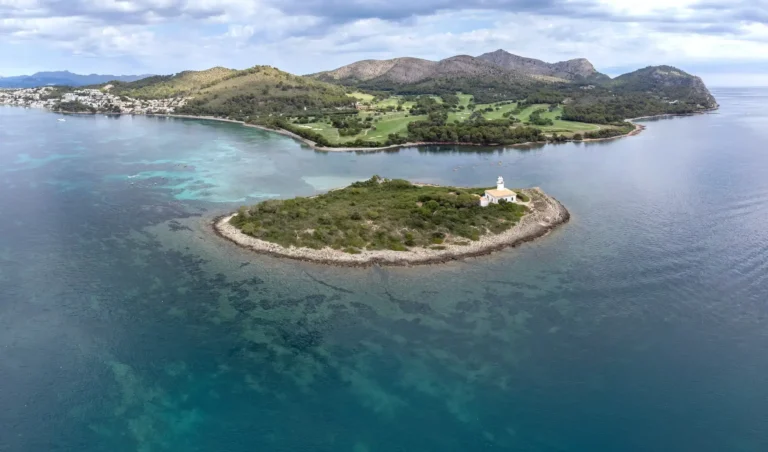
The Punta de l'Avançada Lighthouse stands at the tip of the point, inside a military zone closed to the public since 1940. It can only be seen from the sea.
The Punta de l'Avançada Lighthouse stands at the end of the Bay of Pollença, on a small peninsula very close to Port de Pollença. It was inaugurated in 1905 and remains in service. This is not a conventional visitor attraction: the lighthouse sits inside the military compound of the Port de Pollença seaplane base, so it cannot be visited freely or reached by land without authorisation.
The most practical way to see it is from the sea, on a boat trip around the Bay of Pollença. From the boat you get a better sense of its position in the bay and its relationship with La Fortaleza de Albercuix, the 17th-century defensive structure on the same peninsula.
Where it is
The lighthouse stands on the Punta de l'Avançada, a promontory in the Bay of Pollença in northern Mallorca.
Coordinates: 39°53'59" N, 3°6'37" E
| Port de Pollença | ~2-5 km (depending on the reference point) |
| Port of Alcúdia | ~18-22 km by road |
Quick facts
| Official name | Faro de Punta de la Avanzada / Far de Punta de l'Avançada |
| Municipality | Pollença |
| Year requested | 1897 |
| Project approval | December 1898 |
| Construction began | 1903 |
| Inauguration | 15 December 1905 |
| Project author | Eusebi Estada |
| Height above sea level | 29 m |
| Tower height | 18 m |
| Daytime appearance | Octagonal ashlar tower on a building |
| Light characteristic | Group of 2 occultations every 8 seconds |
| Nominal range | 15 nautical miles |
| Status | Operational |
| Access | Restricted (military zone) |
| Open to visitors inside | No |
Is it worth visiting?
It is worth including if you are interested in little-known lighthouses with restricted access, want to understand the history of navigation in the Bay of Pollença, or are following a boat route along northern Mallorca.
It is not suitable if you expect to go inside the lighthouse or climb the tower, want unrestricted road access, or are looking for a visitor-friendly lighthouse with parking and a viewpoint. It offers none of those things.
The lighthouse is more interesting as an element of the nautical landscape seen from the sea than as a destination on land.
History and context
The origin of the lighthouse is directly linked to maritime safety in the Bay of Pollença.
In 1897, the mayor of Pollença asked the Directorate-General of Public Works to build a lighthouse on the Punta de la Avanzada. The location was approved in December 1898. Construction began in 1903 and the lighthouse was inaugurated on 15 December 1905. Its original system had a distinctive light characteristic, with short and long flashes separated by occultations.
It initially used a 250 mm dioptric optic for wick lamps. It also featured an incandescent lamp for foggy days made by Barbier, Benard & Turenne, the first of its kind used in the Balearics.
In 1953 the signal was electrified. In 1974 the tower was raised by six metres, the turret was modified and the lantern replaced. The original lantern was restored by the Balearic Port Authority and can be seen today in the maritime signals exhibition at the Portopí Lighthouse in Palma.
One episode that went on record: on 27 January 1909, the lighthouse keeper's youngest son raised the alarm about a felucca that was sinking with two crew members aboard. Only one of the sailors could be saved.
The Punta de l'Avançada and La Fortaleza
The lighthouse cannot really be understood without placing it in its setting.
The Punta de l'Avançada is a small strategic peninsula at the entrance to the natural harbour of the Bay of Pollença. Nearby stands La Fortaleza de Albercuix, a defensive structure whose origins date back to the 17th century. A first defensive building was completed in 1628; between 1682 and 1692 a second, hexagonal building was constructed, which serves as the base of the current fortification. It was designed to defend the bay against corsair attacks.
In time, the State sold the property. In 1919, the artist and patron Roberto Ramaugé bought it and converted it into a residence, linked to the artistic circles of Pollença in the first third of the 20th century. During the Civil War, the area was requisitioned by the Air Force and became part of the military zone around the seaplane base.
Its military heritage, private ownership, maritime signalling and coastal setting explain why the area is interesting but difficult to visit.
Restrictions and permits
The lighthouse sits inside the military compound of the Port de Pollença seaplane base.
By land: this is not a freely accessible lighthouse. You cannot drive up as a tourist, park and walk to the tower. The area is part of the military compound and has no regular tourist access.
By sea: it can be seen from a distance from boats that respect the restricted zones. Going ashore is not permitted.
Photography: the lighthouse can be photographed from outside and from the sea, provided you do not enter the military zone or photograph sensitive installations.
Drones: not advisable. The military zone and the proximity of an air base mean recreational flying is not possible without specific permits from AESA and the relevant authorities.
How to see or visit it
From land
Free access by land is not possible. The area is part of the military compound. There is no tourist parking next to the lighthouse and no public footpaths reaching the tower.
It can be partially seen from outer points around the Bay of Pollença or from Port de Pollença at certain angles, but without approaching the lighthouse itself.
From the sea
Since land access is restricted, seeing it from the sea is also the most complete way to understand this lighthouse. From the boat you can better appreciate why it was built precisely at this point to mark the entrance and guide navigation within the Bay of Pollença.
Our boat trips towards Formentor cover this stretch of the Bay of Pollença. For anyone who wants to spend more time in this area, our Private Boat Trips allow you to adapt the route and view the lighthouse, always from the permitted distance.
None of the trips lands in the area or enters the restricted zones.
What it looks like from the sea
From the sea, the lighthouse appears as a low, compact tower, more discreet than the Formentor Lighthouse or the Aucanada Lighthouse. Its understated appearance can be surprising given its importance within the wider setting of the bay. Rather than standing out for its height, it is notable for its position and its role as a navigation marker.
Sailing towards Formentor from Alcúdia, the lighthouse appears as a landmark at the entrance to the Bay of Pollença before the boat heads for the cliffs of the Formentor Peninsula. La Fortaleza de Albercuix is visible in the same setting.
It is not a monumental lighthouse. It is more interesting to those who want to understand the area's navigation and history than to those looking for a dramatic image.
Photography
From land, photography is limited because there is no free access to the lighthouse. If you find a view from outside the restricted zone, a telephoto lens to isolate the tower and framings that include the Bay of Pollença give the best results.
From the boat, use a medium or long focal length. Avoid framings that include military installations. The best angles are the lighthouse on the coastline and the profile of La Fortaleza with the Bay of Pollença in the background.
Drone: not advisable. The military zone and the seaplane base make flying especially sensitive.
When to go
To see it from the sea, spring and autumn are the best seasons: less maritime traffic, softer light and good sailing conditions in the bay.
Morning offers clearer light and less heat. The afternoon brings warmer tones but a greater risk of backlighting, depending on the boat's position.
Practical tips
Do not plan an independent visit by land. Regular tourist access does not exist.
If it comes up in the context of one of our boat trips, note clearly that it is seen from the sea and not as a stop.
For photography: best from a boat with a telephoto lens. Keep military installations out of the frame.
Frequently asked questions
Can you visit the Punta de l'Avançada Lighthouse?
Not freely. It is inside the military compound of the Port de Pollença seaplane base.
Can you go inside the lighthouse?
No. There is no public access to the tower and no regular interior visits.
Where exactly is it?
On the Punta de l'Avançada, in the Bay of Pollença, in northern Mallorca. Coordinates: 39°53'59" N, 3°6'37" E.
What is the best way to see it?
From the sea. Our private boat trips are the most flexible option: they let you approach the point and view the lighthouse from the water, something impossible by land given the restricted military access.
Is there parking nearby?
There is no tourist parking next to the lighthouse.
Can you photograph it?
Yes, from the sea or from outer points. Avoid photographing military installations.
Can you use a drone?
No. The military zone and the seaplane base mean flying requires specific permits.
Is it worth including on a boat route?
Yes, if the goal is to better understand the Bay of Pollença and its nautical history. It is not the most visually striking lighthouse, but it is one of the most singular for its location and restricted access.
How does it differ from the Formentor Lighthouse?
The Formentor Lighthouse is a well-known visitor attraction, with road access and panoramic views. The Punta de l'Avançada Lighthouse is more discreet, lies within a military zone and is best understood from the sea.

Artà is a municipality in northeastern Mallorca with an inland old town and an unspoilt coastline. It is not a beach town but a gateway to the Llevant Natural Park and the wildest coves of the east coast.

The Necropolis of Son Real is one of Mallorca’s most important archaeological sites, with 143 Talayotic tombs on the coast of the Bay of Alcúdia. It sits just metres from the sea and can be seen from our boat trips.

The Llevant Natural Park protects the most unspoilt stretch of Mallorca’s northeastern coast, with cliffs over 200 metres high, sea caves and coves with no road access. It is the destination of our Coves and Caves boat trip.

150 metres from Alcanada beach lies a 4-hectare islet covered in pines and crowned by the Aucanada Lighthouse, in service since 1861. The water around it is among the clearest in the Bay of Alcúdia, thanks to the posidonia meadows.

The Port of Alcúdia is the departure point for all our boat trips and also a destination in its own right: seafront promenade, restaurants and direct access to the beach. In July and August the parking fills up before 10:00.

The Bay of Pollença is the most nautical bay in northern Mallorca. Sheltered by Cap Pinar and the Formentor Peninsula, it has calm waters almost all year round and unspoilt coves reachable only from the sea or on foot.