Aerial view of Formentor Lighthouse on the cliffs of the Formentor Peninsula in northern Mallorca, surrounded by the Mediterranean Sea.

Formentor Peninsula in Mallorca: Complete Guide to Exploring It by Land and Sea

The Formentor Peninsula is an 18-kilometre stretch of land that extends into the Mediterranean from the northern tip of Mallorca, separating Pollensa Bay from the open sea. It is home to some of the island’s most photographed cliffs, several unspoilt coves that can only be reached by boat or on foot, and the iconic Formentor Lighthouse, which has been guiding ships since the 19th century.

Driving to Formentor in July or August can be challenging, as seasonal traffic restrictions come into force on 15 May. When the road is closed or heavily congested, travelling by sea is not only the easiest way to reach the peninsula but also the best way to experience it. Our Formentor and Cap de Formentor boat trip follows the spectacular northern coastline, passes beneath the lighthouse and arrives at Formentor Beach, where you’ll have an hour to swim and relax. From the sea, the sheer scale of the cliffs becomes truly apparent, hidden coves reveal themselves from the water, and the lighthouse can be admired from a perspective that simply isn’t possible from land.

Location

The Formentor Peninsula begins near the Mirador des Colomer viewpoint, around 3 km from Port de Pollença, and stretches as far as Formentor Lighthouse, approximately 16.3 km from the port.

Quick Facts

Official nameFormentor Peninsula
MunicipalityPollença
TypePeninsula
Highest point434 m (El Pal) / 384 m (Puig Fumat)
Approximate length18 km
Road accessRestricted from 15 May to 15 October, 10:00 am–10:00 pm, for private vehicles
Sea accessFree; anchoring permitted on sandy seabeds or at the Formentor mooring buoy field
Environmental protectionSerra de Tramuntana UNESCO World Heritage Site; Natura 2000 Network
Most iconic landmarkFormentor Lighthouse
Best way to visitBy boat (no access restrictions) or by bus 334 during the season

How to Get There and Explore the Peninsula

By land

During the season: take bus 334 from Port de Pollença or Alcúdia, or arrive before 10:00 am.

Outside the season: drive along the Ma-2210. The road is narrow and winding, so drive with care.

Hiking trails: from the Mirador des Colomer viewpoint, a paved road leads up to Talaia d’Albercutx, a 16th-century watchtower standing 380 metres above sea level. From the top, you’ll enjoy panoramic views over Pollensa Bay, Alcúdia Bay and the Serra de Tramuntana.

From the Formentor Beach car park, several hiking trails lead to Cala Murta and Cala Figuera (around 1 hour 30 minutes) and to Cala en Gossalba (around 2 hours), passing through Mediterranean pine and holm oak forests. Experienced hikers can also reach Puig Fumat (384 m) or Na Blanca via mountain trails.

Maps and information about the different hiking routes are available at the Port de Pollença Tourist Information Office.

Our Formentor and Cap de Formentor boat trip departs from Port d’Alcúdia, rounds Cap Pinar and cruises along the peninsula’s spectacular northern coastline before entering Pollensa Bay. Along the way, you’ll admire towering cliffs rising up to 300 metres above the sea, enjoy unique views of Formentor Lighthouse from the water, and discover the unspoilt coves of Cala Murta and Cala en Gossalba. The excursion includes a one-hour stop at Formentor Beach for swimming and, depending on sea conditions, may also include an additional swim stop in one of the sheltered coves within the bay.

Our private boat tours give you the flexibility to spend more time in your favourite coves and tailor the itinerary to sea conditions and your group’s preferences.

Anchoring is permitted on sandy seabeds. Off Formentor Beach, there is an eco-friendly mooring field with around 70 buoys managed by Ports IB (VHF Channel 77).

Is It Worth Visiting?

Absolutely. The Formentor Peninsula is one of Mallorca’s most iconic landscapes and, although road access can be challenging during the summer months, the scenery more than rewards the extra planning.

By boat, there are no access restrictions. You can reach Formentor Beach, admire the unspoilt coves of Cala Murta and Cala en Gossalba from the water, and enjoy views of Formentor Lighthouse from an angle that’s simply impossible to experience from land.

If you’re visiting by car during the high season, it’s best to arrive before 9:00 am or after 10:00 pm, or use the seasonal shuttle bus from Port de Pollença. Outside the summer season (November to May), the road is fully open and the peninsula is much quieter.

The only disappointment may be if you’re expecting to go inside the lighthouse, which is closed to visitors, or if you’re looking for a fully serviced beach in the middle of August without planning ahead.

Landscape and Geography

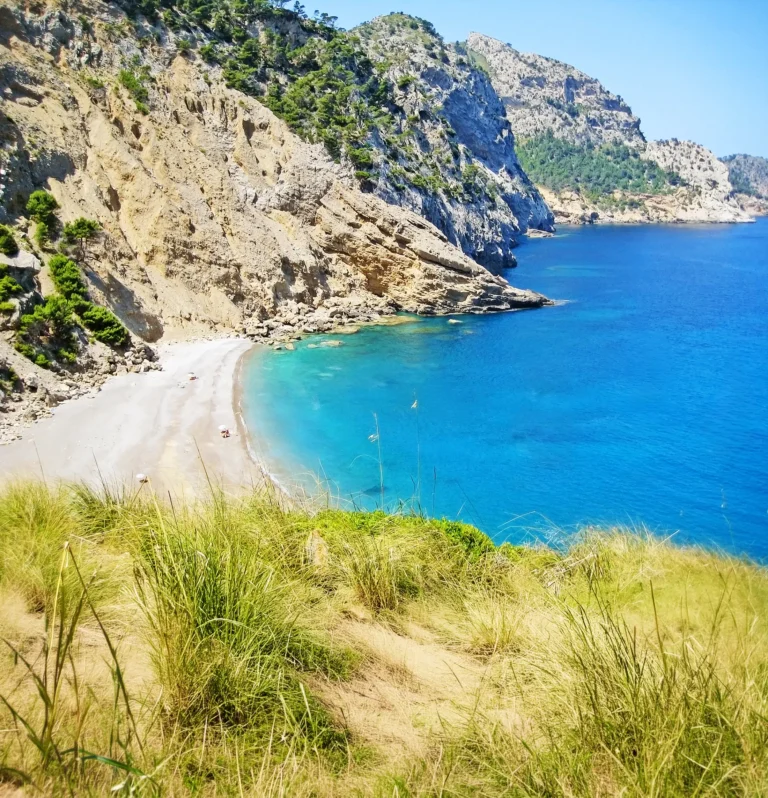
The peninsula is formed of Mesozoic limestone, creating a dramatic landscape of rugged ridges and towering cliffs. Along the northern coastline, cliffs rise up to 300 metres above the Mediterranean, facing the Menorca Channel. The southern side is gentler, with sheltered coves and the famous Formentor Beach.

The highest ridge reaches El Pal (434 m), a protected area with no public access, while nearby Puig Fumat (384 m) can be reached on foot via mountain trails. The Ma-2210 follows the spine of the peninsula from east to west, winding through mountains and cliffs with several viewpoints offering spectacular views over Pollensa Bay, Alcúdia Bay, the Serra de Tramuntana and Mallorca’s northern coastline.

The landscape is dominated by Aleppo pine (Pinus halepensis), together with wild olive trees, Mediterranean scrub and reeds. One of the peninsula’s botanical treasures is the Formentor violet (Viola jaubertiana), an endemic species found only in this part of Mallorca.

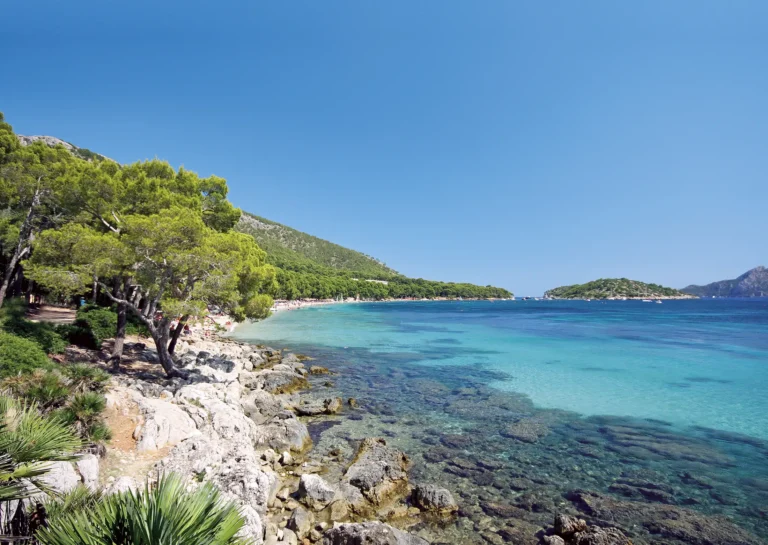
Panoramic view of the Formentor Peninsula in Mallorca from a viewpoint, with its cliffs, Mediterranean forests and Pollença Bay in the background.

Nature and Wildlife

The Formentor Peninsula is one of the best places on Mallorca’s northern coast to observe seabirds and birds of prey, particularly during the migration seasons.

Birds

Eleonora’s falcon (Falco eleonorae) is the species most closely associated with the peninsula. An important breeding colony nests on the northern cliffs. Its breeding season runs from August to October and coincides with the migration of thousands of small birds travelling to Africa, which provide its main source of food. It is often seen soaring above the cliffs or hunting over the sea.

The Balearic shearwater (Puffinus mauretanicus) skims low over the waves and is regularly seen from boats cruising along the northern coastline. Its global population is estimated at around 3,000 breeding pairs, with Mallorca being one of its most important breeding areas.

The cliffs are also home to the European shag, Audouin’s gull and the peregrine falcon. Inland, the pine and holm oak forests provide habitat for the Balearic warbler, an endemic species of the Balearic Islands, as well as the firecrest and the common crossbill. During the spring migration, several species of birds of prey can often be seen passing over the tip of the peninsula on the same day.

Mammals

The wild Majorcan goat is frequently seen descending towards the coastline and is a common sight along hiking trails and on the edges of the cliffs.

Flora

Aleppo pine (Pinus halepensis) covers most of the peninsula. In the more exposed areas, you’ll also find holm oak, wild olive trees, Mediterranean scrubland and reeds. The Formentor violet (Viola jaubertiana) is endemic to these cliffs and blooms in spring from cracks and rocky ledges.

Marine Life

The coves along the southern side of the peninsula, especially Cala Murta and Cala Figuera, are home to well-preserved meadows of Posidonia oceanica growing over rocky and sandy seabeds. Visibility often reaches 15–20 metres on calm days. Sea anemones, starfish and a variety of fish can often be seen among the rocks and seagrass. At Cala Figuera, the seagrass begins at depths of around 3–5 metres. Posidonia is legally protected, and its presence is a clear indicator of excellent water quality.

2026 Access Restrictions

From 15 May to 15 October, between 10:00 am and 10:00 pm, private vehicles are not permitted to circulate freely on the Ma-2210.

Zone 1 – Port de Pollença to Formentor Beach

Access is permitted until the 300-space car park reaches full capacity.

Zone 2 – Formentor Beach to Formentor Lighthouse

This section is completely closed to private vehicles during the restricted hours.

Shuttle Bus 334

Bus 334 operates from both Alcúdia and Port de Pollença, stopping at Mirador Es Colomer, Formentor Beach, Cala Figuera, Cala Murta and Formentor Lighthouse. During the restriction period, buses run approximately every 35 minutes. The journey from Port de Pollença to the lighthouse takes around 50 minutes. Up-to-date timetables and fares are available at tib.org.

Unauthorised access may result in fines ranging from €100 to €200.

Outside the restricted season, the road is fully open. We recommend visiting at sunrise or sunset. The early morning light at Formentor Lighthouse, on a clear day, offers one of the most memorable views in northern Mallorca.

Panoramic view of the Formentor Peninsula in Mallorca from a viewpoint, overlooking Pollença Bay, the Serra de Tramuntana and the island’s northern coastline.

Points of Interest

Mirador des Colomer – The first viewpoint on the road into the peninsula, offering spectacular views over Pollensa Bay. Easily accessible by road.

Talaia d’Albercutx – A 16th-century watchtower standing at 380 metres above sea level. Reached via a walking trail from the road.

Formentor Beach (Cala Pi de la Posada) – A sandy beach with crystal-clear turquoise waters and the shade of Mediterranean pine trees. Facilities include sun loungers, a restaurant, showers and a paid car park.

Cala Murta, Cala Figuera and Cala en Gossalba – Unspoilt pebble coves that can be reached either on foot or by boat in around 20–30 minutes. No facilities are available.

Formentor Lighthouse – Located at the tip of the peninsula, this 22-metre-high lighthouse remains fully operational but is not open to visitors.

The Peninsula from the Sea

Seen from the water, the Formentor Peninsula reveals an entirely different side of its landscape. The towering northern cliffs, rising up to 300 metres above the Mediterranean, can be admired in their full height from sea level. Formentor Lighthouse stands at the tip of the headland, while the hidden coves gradually come into full view as the boat approaches.

Cala Murta and Cala en Gossalba can only be reached on foot or by sea. From the boat, the entrance to each cove gradually opens up, while the water changes from deep blue to vivid turquoise as the seabed becomes shallower.

In our experience, the stretch between Cap de Formentor and Cala Murta offers the peninsula’s most spectacular cliff scenery. Here, an almost uninterrupted wall of rock rises dramatically above the sea in a way that’s impossible to appreciate from land.

When to Visit

By boat: from April to October. May, June, September and October generally offer less boat traffic and better light than the peak summer months.

By road: the quietest time to visit is outside the summer season, or before 10:00 am during the summer months. Visiting Formentor Lighthouse early in the morning on a clear day is well worth the effort.

For hiking: spring and autumn are the best seasons. The trail from Formentor Beach to Cala Murta passes through pine and holm oak woodland, with several shaded sections. Hiking is still possible in summer, but it’s essential to set off early and carry plenty of water. Cyclists can also reach the peninsula from Port de Pollença via the Ma-2210, which remains open to bicycles even during the seasonal traffic restrictions. The ride to Formentor Beach takes around one hour. Maps for mountain routes such as Puig Fumat and Na Blanca are available from the Port de Pollença Tourist Information Office.

Practical Tips

Before travelling during the summer, check the latest traffic restrictions. Bus 334 is the easiest way to reach Formentor Lighthouse without worrying about road closures or parking.

If you’re hiking to the coves, wear sturdy footwear, take plenty of water and remember that the trails are not suitable for strollers.

If you plan to anchor off Formentor Beach, always anchor on sandy seabeds. Using the eco-friendly mooring buoys managed by Ports IB is the most environmentally responsible way to protect the Posidonia oceanica meadows.

Frequently Asked Questions

Can you visit the Formentor Peninsula by road, or is it only accessible by sea?

Yes, you can visit by road, although seasonal traffic restrictions apply during the summer months. There are no access restrictions by sea, making a boat trip the easiest and most convenient way to explore the peninsula during the high season.
You’ll enjoy views of the peninsula’s towering northern cliffs, rising up to 300 metres above the Mediterranean, the unspoilt coves of Cala Murta and Cala en Gossalba from the water, and Formentor Lighthouse perched at the tip of the headland.
It depends on the experience you’re looking for. A boat trip gives you access to the hidden coves without the need for hiking and offers spectacular views of the cliffs from the sea. Exploring on foot allows you to reach the lighthouse, the viewpoints and the inland hiking trails. The two experiences are complementary rather than interchangeable.
Yes. From 15 May to 15 October, private vehicles are restricted on the Ma-2210 between 10:00 am and 10:00 pm. Shuttle Bus 334 provides an alternative way to reach the peninsula during these hours. Unauthorised access may result in fines of €100–€200.
Yes. From the Formentor Beach car park, hiking trails lead to Cala Murta and Cala Figuera (around 1 hour 30 minutes), Cala en Gossalba (around 2 hours) and Talaia d’Albercutx. More experienced hikers can also climb Puig Fumat or Na Blanca. The trails pass through pine and holm oak woodland, with several open sections overlooking the northern coastline. Maps are available from the Port de Pollença Tourist Information Office.
Our Formentor and Cap de Formentor boat trip and our private boat tours offer the best views of the peninsula’s spectacular northern coastline, its towering cliffs and Formentor Lighthouse from the sea.
There is a paid car park at Formentor Beach. During the restricted season, private vehicles are not permitted to park at Formentor Lighthouse.
Contents
The Alcudia Sea Trips Blog
Ideas, guides and hidden gems to explore Mallorca’s northern coast.
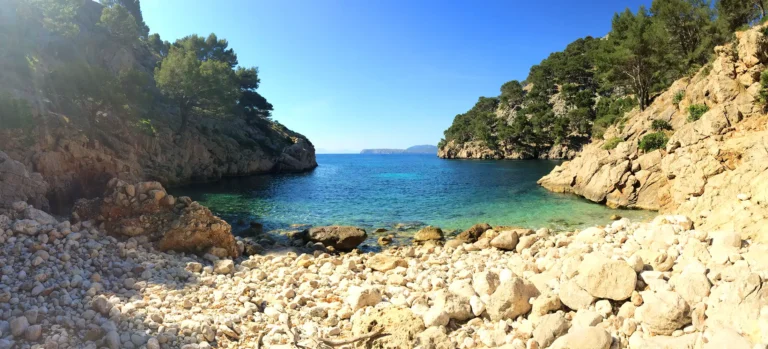
Cala en Gossalba with crystal-clear waters and rocky cliffs on the Formentor peninsula
Cala en Gossalba in Mallorca. Practical guide and tips for visiting

Cala en Gossalba is one of those coves that does not appear in travel brochures. It is hidden on the Formentor peninsula, between cliffs, pine trees and mountain slopes that drop straight down to the sea, and it can only be reached by walking for around 30 minutes along a steep path or by arriving from the sea. There is no sand, no beach bar, no lifeguard. What it does
Read more »
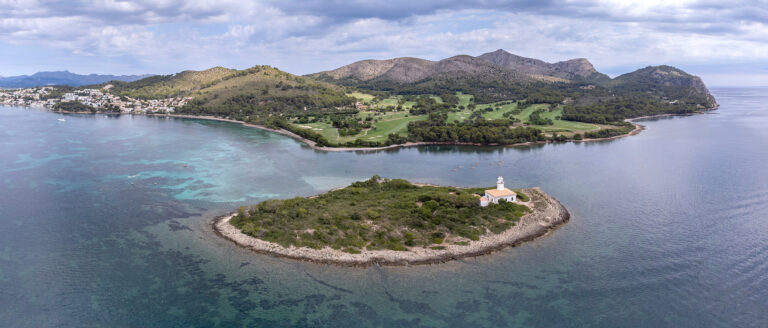
Panoramic aerial photograph of the islet of Alcanada with its lighthouse, the golf course and the coast of Alcúdia in the background over turquoise waters.
Alcanada Beach, Mallorca: the quietest beach in the Bay of Alcúdia

Alcanada Beach is not the best-known beach in northern Mallorca, and that is exactly what makes it so interesting. It is located three kilometres from the port of Alcúdia, facing a small islet with its own lighthouse, with pine trees reaching almost down to the shore and offering shade when many other beaches in the area are in full sun. It is a popular beach among local residents and families
Read more »
Snorkeling on a Private Boat Trip in Mallorca
Snorkeling in Mallorca: best areas and boat trips

Snorkeling in Mallorca: Best Spots and Coves Mallorca is one of the top Mediterranean destinations for snorkeling, thanks to its crystal-clear waters, rich marine life, and the wide variety of coves and sea caves that surround the island. From easily accessible coastal spots to more remote, unspoiled locations, snorkeling in Mallorca offers a unique experience for both beginners and ocean lovers alike. Although snorkeling can be enjoyed from many beaches,

Read more »