Bay of Alcúdia Mallorca: Guide to Beaches and Boat Trips
The Bay of Alcúdia forms the great coastal arc of northern Mallorca, with 10 kilometres of fine sand between the Port of Alcúdia and Can Picafort. It is the starting point of all our boat trips.
The Bay of Alcúdia is the setting where practically every boat outing in northern Mallorca begins. Before reaching cliffs, lighthouses or hidden coves, every route crosses this great arc of water stretching between Cap Pinar and Cap Farrutx.
As you sail across it, it is easy to notice how the colour of the sea changes, how the sand gives way to posidonia in places, and how the landscape shifts from long beaches to more rugged shores. To understand northern Mallorca it is worth getting to know this bay first, because it shapes much of the sailing and the boat trips in the area.
Where it is and what it is like
The Bay of Alcúdia is the largest inlet in northern Mallorca. Its boundaries are Cap Pinar to the northwest and Cap Farrutx to the east. Along its shore lie the municipalities of Alcúdia, Muro, Santa Margalida and Artà.
Quick facts
| Name | Bay of Alcúdia (Badia d'Alcúdia) |
| Municipalities | Alcúdia, Muro, Santa Margalida, Artà |
| Approximate length | 30 km |
| Maximum width | ~5 km |
| Maximum depth | 15-30 m in the central area |
| Predominant seabed | Fine sand in the central area; posidonia and rock at the ends |
| Main ports | Port d'Alcúdia |
| Best activity | Sailing, swimming, snorkelling, water sports |
| Environmental protection | SCI (Site of Community Importance), Natura 2000 network (ES5310005 Badies de Pollença i Alcúdia) |
Is the Bay of Alcúdia worth visiting?
The Bay of Alcúdia is not a destination you visit the way you visit a lighthouse or a cove. If you are already in northern Mallorca, you are already in it.
It is worth understanding the bay before deciding what to do. The sandy central seabed keeps the water clear. Its orientation shelters it from the tramontana for most of the year. It is large enough to sail, anchor and explore without leaving the bay. Anyone boarding one of our boats will travel across these waters.
What is in the bay
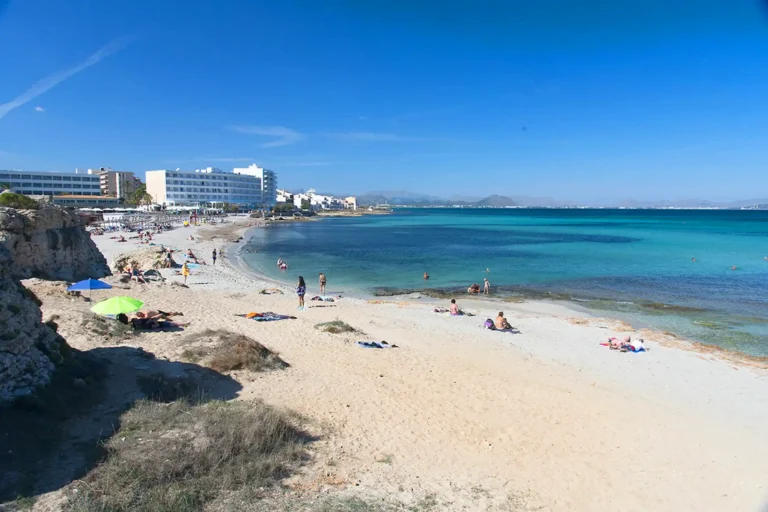
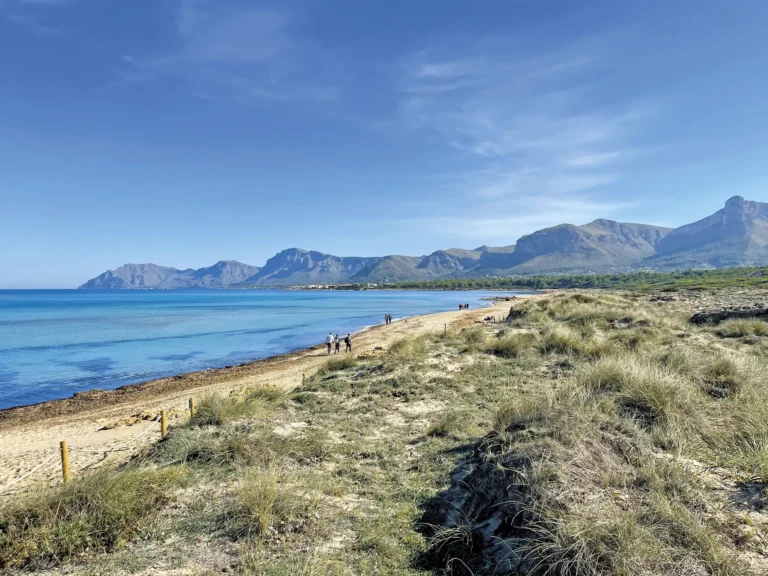
The perimeter changes a great deal from one stretch to the next. The northwestern end, Cap Pinar, is a military zone with no access: the wildest part, and the one best seen from the sea. To the west, Port d'Alcúdia has its seafront promenade and Alcúdia beach with full facilities. Further southwest, Playa de Muro is a continuous stretch of sand bordering the s'Albufera Natural Park. At the southern end, the villages of Can Picafort and Son Serra de Marina have quieter beaches, and beyond them begins the territory of the Llevant Natural Park.
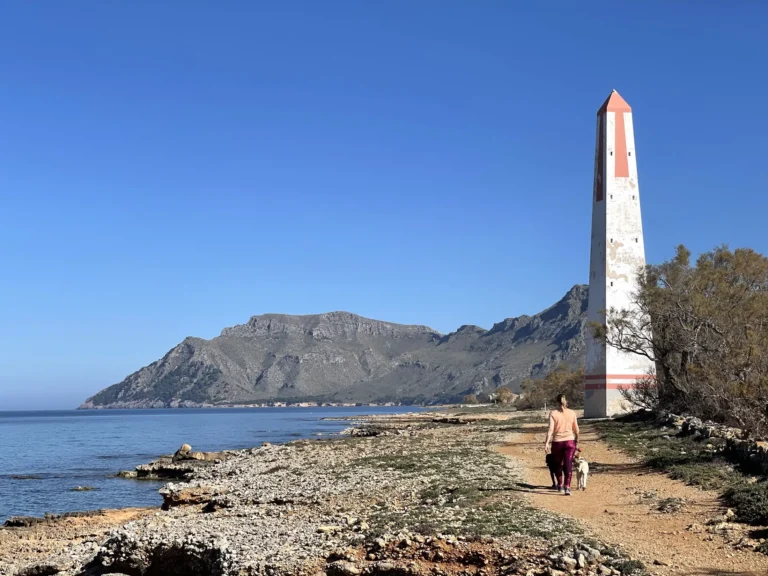
The Alcanada islet, opposite the beach of the same name, is the bay's only islet. It holds the Aucanada Lighthouse (1861) and is ringed by protected posidonia meadows.
What you can do
Sailing and anchoring. Conditions in the bay are usually calm, with a sandy seabed in the central area that makes anchoring straightforward. The summer embat (a southerly breeze, force 2-4) is well suited to dinghy sailing. The marina at the Port of Alcúdia has around 700 moorings with services.
Swimming and snorkelling. The sandy seabed gives remarkable visibility in the central area. The best snorkelling spots are near the Alcanada islet, where the posidonia and marine life are more varied.
Water sports. Windsurfing and kitesurfing are common around Muro and Can Picafort. Paddleboarding and kayaking from any point along the coast.
Boat trips. All our boat trips depart from the Port of Alcúdia.
Sailing and anchoring
Free anchoring. Over sandy bottoms, anywhere in the bay, keeping the minimum distance from the shore and from other vessels. The anchor must not touch the posidonia.
Usual maritime traffic. Ferries to Menorca and Barcelona from Alcúdia's commercial quay, our boat trips, sailboats and private yachts in high season, jet skis off Alcúdia beach. In July and August traffic is heavy between the port and the Alcanada islet.
Shelter from winds. The bay is protected from the tramontana by the mass of La Victòria and Cap Pinar to the northwest. It is more exposed to easterly winds and the southerly embat.
Precautions. The embat wind can build up mid-morning and reach force 3-4 in summer, fine for sailing but uncomfortable for small boats without experience.
Boat trips
All our boat trips depart from the Port of Alcúdia, so the bay is always the first landscape of the journey. From the water you can easily make out the changing colours of the seabed, the moment the sand gives way to posidonia, the profile of Cap Pinar closing the horizon and the true size of the Alcanada islet, which usually looks much smaller from land.
The Boat Trip to Formentor crosses the entire bay before rounding Cap Pinar. The Glass Bottom Boat covers the central area, passing close to the Alcanada islet. The Coves and Caves reaches the eastern end, where the bay gives way to the coast of the Llevant Natural Park.
When to go and sea conditions
The bay offers a different picture in every season of the year, and that shows while sailing too.
Spring and autumn (April-June and September-October) are the best times to sail: calm sea, manageable wind, less traffic.
In summer (July-August) the water is warm and the sea is usually calm, but traffic is heavy and the beaches are crowded. The afternoon embat can make sailing tricky for small boats.
In winter the bay remains navigable on fine days, but the tramontana can create demanding conditions.
The best time to sail is early in the morning, before the embat builds up.
Access and practical orientation
The main access points are the Port of Alcúdia (tourist quay, marina, ferries), Alcúdia beach (direct access from the seafront promenade), Playa de Muro (signposted car parks off the road), Can Picafort and Son Serra de Marina (access via the Ma-12).
Public transport: intercity buses connect Alcúdia with Palma, Can Picafort and Port de Pollença. In high season there is a service between the bay's coastal villages.
Frequently asked questions
What is the difference between the Bay of Alcúdia and the Bay of Pollença?
The Bay of Alcúdia is larger (30 km of coastline) and has a sandier seabed in the centre. The Bay of Pollença is more sheltered and nautical. Our boat trips depart from Alcúdia and reach Pollença on the routes towards Formentor.
Which beaches are in this bay?
The main ones are Alcúdia beach, Playa de Muro, Can Picafort and Son Serra de Marina. The Alcanada islet has a small beach. Towards Cap Farrutx, the beaches are unspoilt and only accessible on foot or by boat.
Are there dolphins in the Bay of Alcúdia?
Sightings are occasional. We run a dedicated dolphin-watching trip that sets out at dawn towards the areas where they are most frequent.
Can you anchor freely?
Over sand, yes. Areas with posidonia require authorised eco-buoys. Bookings are made at balearslifeposidonia.eu.
When is the sea at its calmest?
Early in the morning, before the embat builds up. May, June and September usually have more stable conditions than midsummer.
Which boat trip covers this bay best?
It depends on the area you want to see. The Glass Bottom Boat covers the central part of the bay and passes close to the Alcanada islet. If you would rather discover how the bay turns into the wild coast of the Llevant Natural Park, the Coves and Caves Boat Trip continues to that end.
Is it good for snorkelling?
Yes, especially near the Alcanada islet and at the ends of the bay where there is posidonia.
Can you sail all year round?
On fine days, yes. Our boat trips operate mainly from April to October.

Artà is a municipality in northeastern Mallorca with an inland old town and an unspoilt coastline. It is not a beach town but a gateway to the Llevant Natural Park and the wildest coves of the east coast.
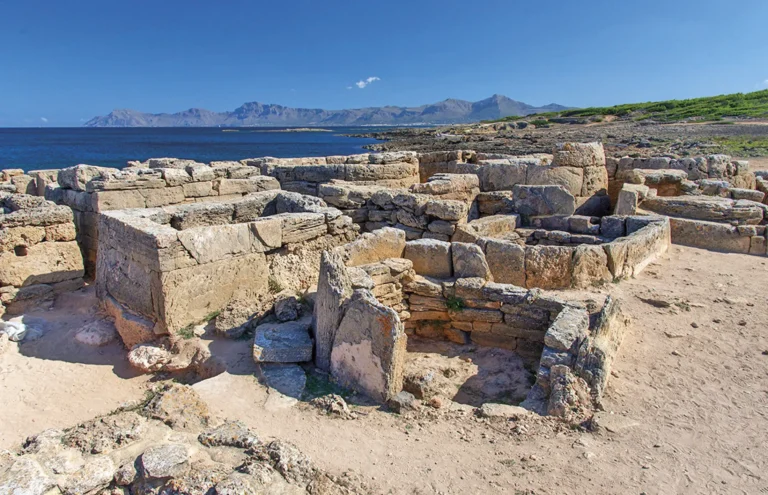
The Necropolis of Son Real is one of Mallorca’s most important archaeological sites, with 143 Talayotic tombs on the coast of the Bay of Alcúdia. It sits just metres from the sea and can be seen from our boat trips.

The Llevant Natural Park protects the most unspoilt stretch of Mallorca’s northeastern coast, with cliffs over 200 metres high, sea caves and coves with no road access. It is the destination of our Coves and Caves boat trip.

150 metres from Alcanada beach lies a 4-hectare islet covered in pines and crowned by the Aucanada Lighthouse, in service since 1861. The water around it is among the clearest in the Bay of Alcúdia, thanks to the posidonia meadows.

The Port of Alcúdia is the departure point for all our boat trips and also a destination in its own right: seafront promenade, restaurants and direct access to the beach. In July and August the parking fills up before 10:00.

The Bay of Pollença is the most nautical bay in northern Mallorca. Sheltered by Cap Pinar and the Formentor Peninsula, it has calm waters almost all year round and unspoilt coves reachable only from the sea or on foot.